Magento 2 REST API Explorer
Browse every Magento 2 REST endpoint, with method, path, parameters, ACL, and paste-ready cURL.

What Magento 2 REST API Explorer does
- ✓ Every REST endpoint declared by Magento 2 core's webapi.xml — Catalog, Customer, Quote, Sales, Inventory, Tax, Store, and 30+ more modules
- ✓ Grouped by module — drill into Customer to see /V1/customers, /V1/customers/me, /V1/customerGroups, or jump to Quote for /V1/carts and /V1/carts/mine
- ✓ Per-endpoint detail page with HTTP method, path/query/body parameters (with type, required flag, default, description), return type, service contract method, and the ACL resources protecting the route
- ✓ Auto-generated examples — paste-ready Headers (Accept, Content-Type, Authorization), JSON body, cURL, and a JavaScript fetch snippet for every endpoint
- ✓ Auth surfaced inline — every endpoint flagged Anonymous, Self (customer/admin), or Admin with the exact ACL identifier (e.g. Magento_Customer::group)
- ✓ Pinned to a specific Magento release — version banner makes provenance explicit; rebuild against a newer source tree by re-running the generator
How it works
Search or browse
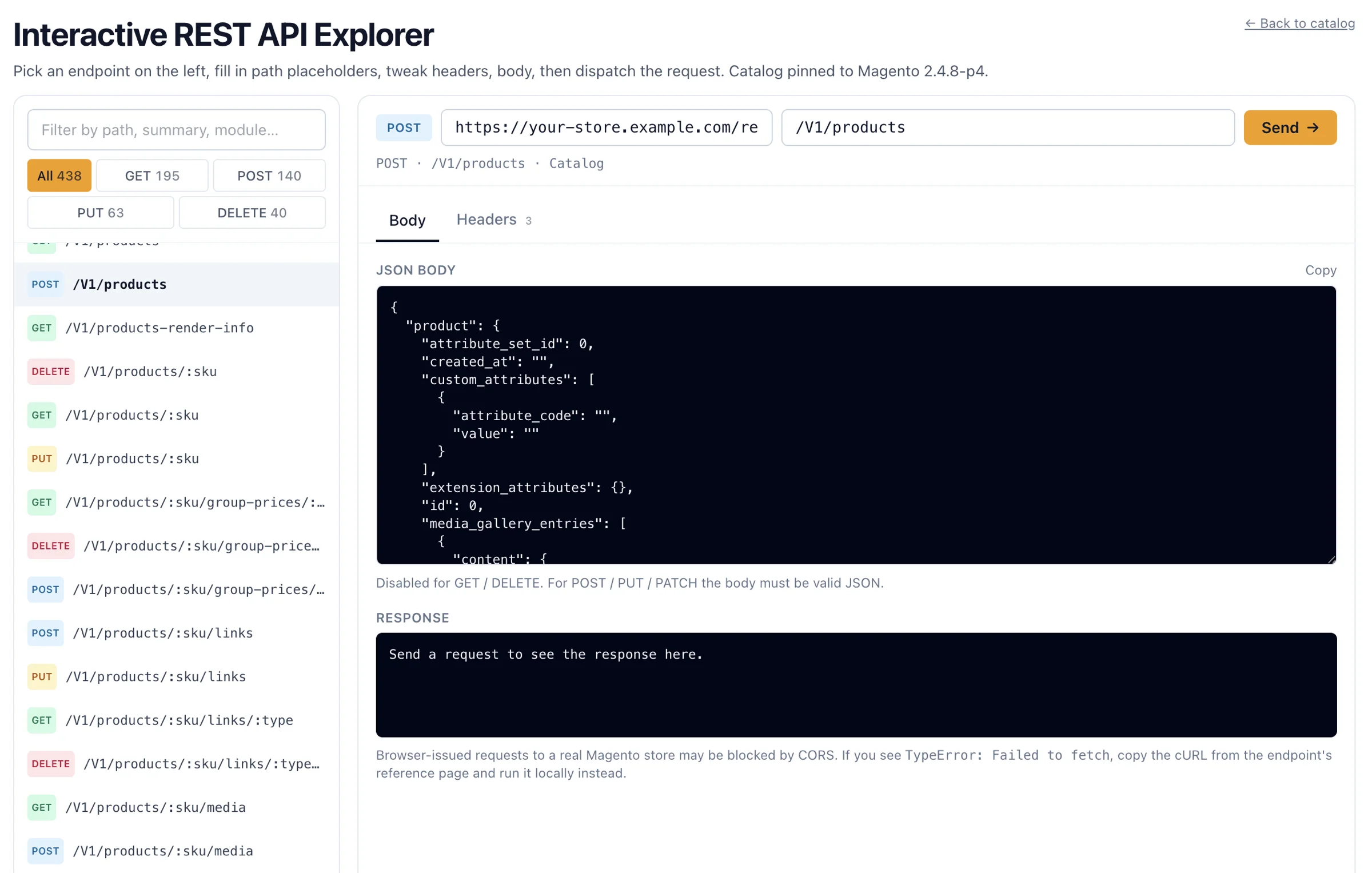
Search by path, service class, summary, or module (e.g. /carts, customer, products), filter by HTTP method, or jump straight into a module's surface from the grid.
Open an endpoint
Per-endpoint page shows path/query/body parameters with types and defaults, return type, service contract, ACL requirement, and a tabbed example block with Headers / Body / cURL / JS fetch.
Send from the playground
/restapi/explorer is a Postman-style sidebar: pick an endpoint, fill in path placeholders, edit headers/body, and dispatch the request directly from the browser.
Frequently asked about Magento 2 REST API Explorer
Where does the catalog data come from? +
It's parsed at build time from every module-*/etc/webapi.xml file plus the matching service contract (Magento\<Module>\Api\<Class>::<method>) PHPDoc. The generator (scripts/restapigen) walks the vendor tree, extracts route + auth metadata from the XML, and pulls @param/@return tags out of the PHP.
Are the example requests safe to copy and run? +
They're paste-ready against your store's /rest/default base, but you'll need to replace the host, ACL token, and any required values. Endpoints flagged Self or Admin require a Bearer token; obtain one via /V1/integration/customer/token (customer) or /V1/integration/admin/token (admin).
Why is the Authorization header sometimes missing? +
Endpoints flagged anonymous in webapi.xml don't need a token at all. The header appears on every endpoint where the <resources> block lists `self` or one or more ACL identifiers.
Does it cover third-party modules? +
Core Magento + the bundled Adobe Commerce modules + PayPal Braintree are included. To add your own module's REST surface, drop a webapi.xml into a vendor module and re-run the generator — custom-module upload is on the roadmap as a per-account feature.
How are body parameters distinguished from path parameters? +
Path parameters are detected from `:name` segments in the URL (like /V1/customers/:customerId); everything else from the service method's @param list goes into Body for POST/PUT/PATCH or Query for GET/DELETE. The split mirrors what Magento's WebAPI module does at request dispatch.
Can I run a request against my store from this page? +
Yes — the /restapi/explorer playground POST/GET/PUTs straight from the browser. Browser CORS rules apply, so most production stores will block the dispatch unless you've configured `Access-Control-Allow-Origin`. When that fails, the catalog still gives you the cURL to run locally.
Related tools
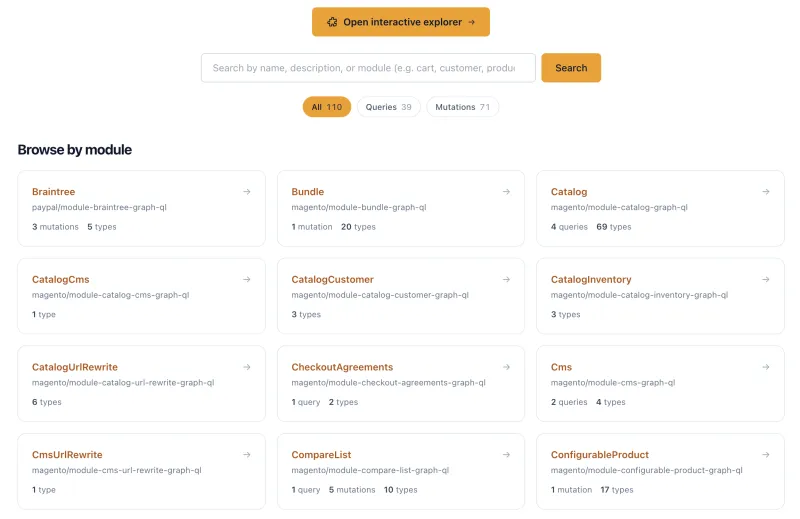
Magento 2 GraphQL Explorer
Browse every Magento 2 GraphQL query and mutation, with paste-ready headers, body, and cURL.
Learn more →
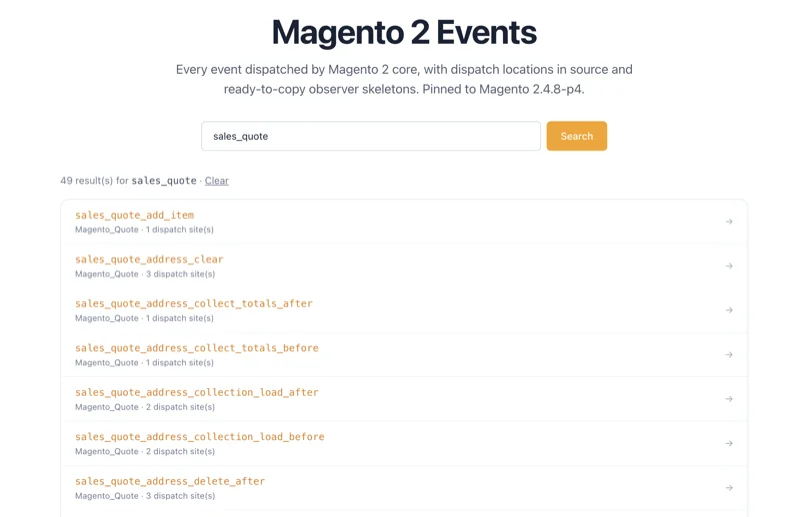
Magento 2 Event Catalog
Every event dispatched by Magento 2 core, with dispatch locations and ready-to-copy observer skeletons.
Learn more →
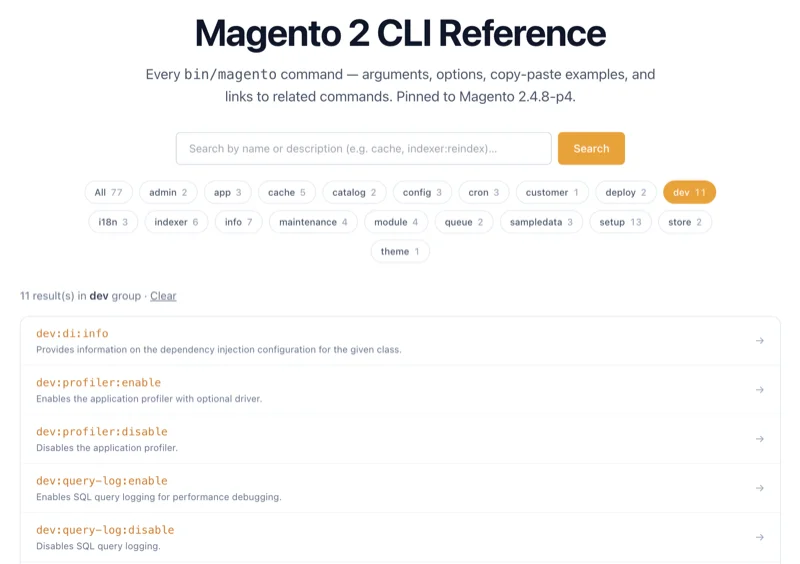
Magento 2 CLI Reference
Every bin/magento command, with arguments, options, and copy-paste examples.
Learn more →
Every Magento dev tool, in one hosted workspace.
Free to sign up. Nothing to install. Drafts, audits, and projects saved across every tool.